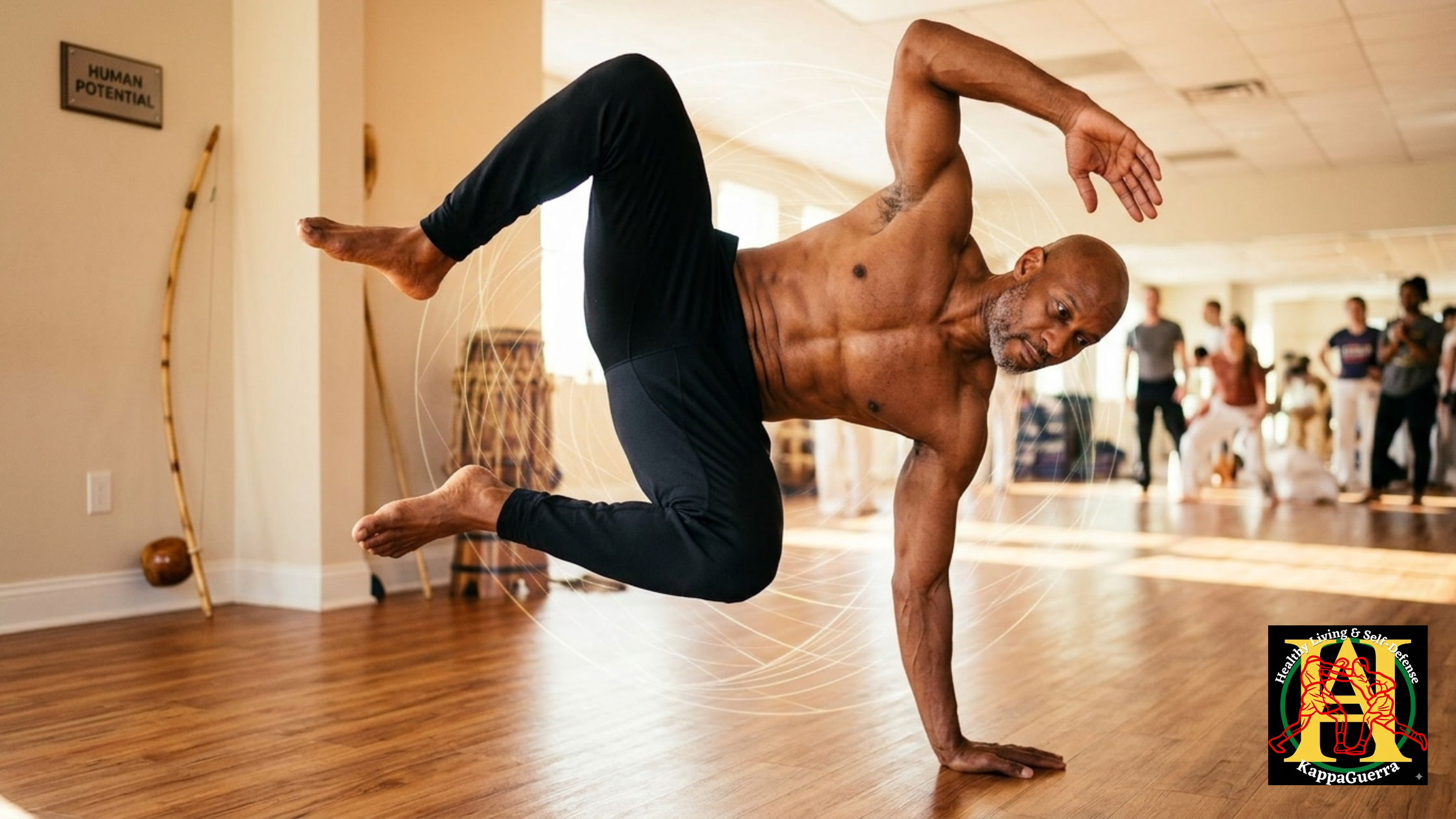
Core Philosophy: The Three Interconnected Modes of KappaGuerra
You know the feeling. Another workout to slog through. Another set of reps to check off. Another day of forcing yourself to do something that’s supposed to be good for you but feels exactly like what it is: work.
There’s another way.
Join the KappaGuerra Team in VB now
Movement doesn’t have to feel like punishment. The healthiest people on the planet didn’t get that way because they were better at grinding through things they hated. They got there because they found forms of movement that genuinely pulled them in—activities with rhythm, with community, with the kind of magnetic pull that makes time disappear and leaves you wondering why you ever thought exercise needed to hurt.
This episode of the KappaGuerra Podcast traces a 34-year journey from street fights to fight rings, from rigid martial arts traditions to a collaborative movement philosophy, from a skinny kid with thick glasses to a man who moves through the world with the kind of freedom most people assume they’ve aged out of. Host Dr. Hakeem Ali-Bocas Alexander lays out the framework that makes sustainable, joyful physical mastery possible for anyone willing to approach movement differently.
What you’ll discover in this conversation:
- The three distinct modes of physical expression that allow you to build body awareness, sharpen strategic thinking, and develop genuine self-protection skills—all while having fun
- Why the traditional hierarchy of teacher-and-student often creates dependency, and how a collaborative “friends playing together” approach unlocks faster, deeper, more sustainable growth
- How rhythm and community transform exercise from obligation into something you actually look forward to
- The specific mindset shifts that preserve physical capability decades longer than conventional training methods
- Why great health becomes the truest wealth when it’s built on joy rather than discipline alone
Press play below to hear the full conversation. Whether you’re a complete beginner wondering where to start or a lifelong mover looking to reconnect with why you started, this episode offers something rare: permission to play again.
Listen to “Dance. Game. Combat. – 34 Years of Falling, Flipping, and Fighting” on Spreaker.Dr. Alexander’s central thesis is that Capoeira, and by extension his system KappaGuerra, is not a monolith. He delineates it into three distinct but interconnected modes, with the understanding that the application of these modes depends on context:
- The Dance:
- Nature: A partnership, a cooperation.
- Goal: To edify your partner and put on a beautiful exhibition (“Joga Bonita”).
- Rules: An unspoken agreement to make both players look good. It’s about flow, rhythm, and showmanship. It is a “badly organized circus” where the priority is aesthetics and fun for the participants and observers.
- The Game:
- Nature: A competition.
- Goal: To use strategy, positioning, and finesse to outmaneuver your opponent. The objective is to be the one with the most options, leaving your opponent vulnerable.
- Rules: The goal is to put your opponent on their butt or back through skill and timing, not brute force. A core tenet he holds is to avoid being put on his own back at all costs. A sweep or takedown here is how you “score.”
- Strategy: You use skillful timing and positioning to create an opening, then execute a takedown with elegance and grace.
- The Martial Art (Combat/Self-Defense):
- Nature: A fight for survival.
- Goal: To inflict maximum damage while sustaining minimal injury, to prevail or escape.
- Rules: Anything goes. It layers the body awareness from the Dance and the positioning from the Game with strikes, throws, environmental weapons, and any other effective technique.
- Key Principle: The flashy movements (flips, spins) are for body awareness and conditioning, not for the fight itself. The fight uses the foundation built by those movements. In this mode, even things not traditionally in Capoeira, like combat rolls, become valid tools.
Foundational Influences on His “Maverick” Approach
Dr. Alexander explains that his view of martial arts as something to be innovated and made brutally effective was shaped long before he ever saw Capoeira.
- Miyamoto Musashi: The legendary swordsman who innovated a two-sword style and was a “maverick” on the “cutting edge.”
- Bruce Lee: The creator of Jeet Kune Do, who broke from tradition to create his own “way of the intercepting fist.”
- Street Fighting: His own experiences as a “scrappy” kid ingrained in him a deep desire for real-world effectiveness and a respect for the unpredictability of a real fight.
- Mike Tyson: Heavily influenced his heavy punching style and aggressive, low-to-the-ground boxing approach.
Key Anecdotes that Shaped His Philosophy
He uses several personal stories to illustrate his journey and the validity of his three-mode philosophy:
- The Master’s Question: His first teacher, Mestre Pele, once asked him, “Okay Morticia, you can fight, but can you play capoeira?” This was a pivotal moment, forcing him to recognize the crucial distinction between the cooperative Dance/competitive Game and the brutal reality of a fight.
- The Counter to the Tesoura (Scissors): In a roda with a hostile player, an opponent attempted a scissor takedown. Dr. Alexander’s ingrained rule from the “Game” mode—to “never land on his back”—caused him to instinctively turn into the move. This resulted in him landing on top and slamming his opponent hard, demonstrating how defensive positioning can neutralize an attack without conscious “fighting” intent.
- The Fast Knockout: When challenged to a real fight by a man named Bruno, he switched instantly into “Combat” mode. He used a Mike Tyson-inspired combo (body shot then hook) to knock him out in seconds, proving the effectiveness of his integrated approach.
- Jiu-Jitsu Rolling: A Brazilian Jiu-Jitsu practitioner noted that Dr. Alexander’s Capoeira background made him incredibly comfortable in unusual positions. Despite having no formal BJJ training, his body awareness from constant inversion and movement allowed him to escape submissions for an unusually long time, validating that the Dance builds a powerful foundation for other fighting arts.
The Ultimate Goal: Athletic Longevity
A major theme is his criticism of martial arts “masters” who become unhealthy and immobile in middle age. He has dedicated himself to proving this is not necessary. At 49, he can still perform backflips and 540-degree spins (“au batido com fusso“). This is his personal proof that a holistic system focused on vitality works. His approach integrates:
- Smart nutrition and recovery.
- A mix of hard training (heavy bags) and playful movement (flips, spins).
- A holistic view connecting the physical, mental, and spiritual.
The Launch of KappaGuerra
This podcast marks the separation of Capoeira content from his HypnoAthletics brand into a dedicated channel for KappaGuerra. This is his own system, born from his broken lineage and eclectic training. It is a framework for sharing his three-mode philosophy and helping others achieve the same level of physical expression, health, and self-defense capability, all within a collaborative, non-hierarchical team structure. It is the practical application of his lifelong study, which also includes PhysioMeditation, Dream Action Yoga, World Reading Club, ExercisingYourMind.com, and the philosophy that “great health is the truest of all wealth.”